The ancient Egyptian civilization is one of the most interesting civilizations in history, full of remarkable achievements, mysterious beliefs and also stories you just remember. For thousands of years Egyptians followed a rich religious system where gods and goddesses had an important role in ordinary life , from protecting people and steering souls to explaining natural events, and the mysteries of existence.
These strong deities were deeply linked with Egyptian culture, art, temples , and customs. Their legends still keep catching attention around the world, giving a special peek into the beliefs and values of one of the oldest societies on Earth.
The era of the Pharaohs is remembered for this incredible civilization, those big architectural things, and a bunch of mysteries that still pull people in today. And one of the big parts of ancient Egyptian culture, was religion, because the Egyptians honored hundreds of gods and goddesses for over 3,000 years.
Religion and the pharaonic civilization were tied together pretty firmly, and historians see it as one of the main building blocks of ancient Egyptian society. Each Egyptian divinity had a job it handled, showing different sides of daily life, nature, guarding, death , and what came after.
If you want to discover the secrets of ancient Egypt, you can follow these stories through Egypt tours, where you get to step inside legendary temples, walk past ancient monuments, and reach sacred locations linked with Egyptian mythology.

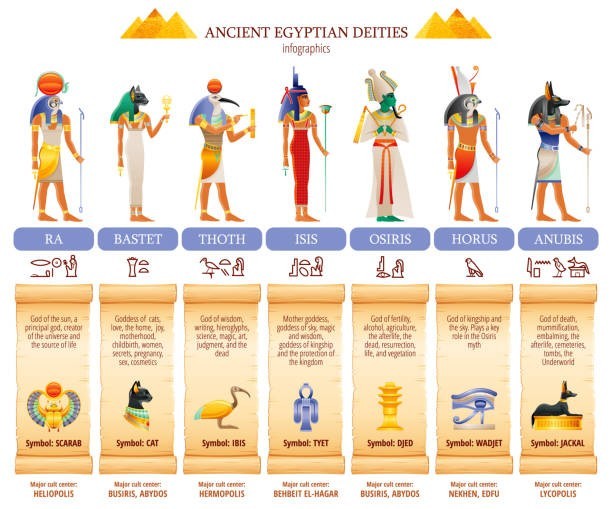
Anubis is, one of the most famous Egyptian gods, people remember him for the whole mummification work, and also for being a guardian of the dead. In most images, he appears as a man with a jackal head and black-colored skin, that black color was tied to rebirth, as well as protection, even if people did not always put it into the same exact words.
Ancient Egyptians believed Anubis would guide souls through the afterlife, and keep watch during burial rites. So in their worldview, his part was important, for the idea of death, and then resurrection after it, like a necessary link you cannot really separate.
Osiris, the master of eternity, was one of the biggest figures in ancient Egypt. He was linked to the afterlife, the rising again, and the weighing, or judgment of the dead.
In Egyptian myth, Osiris ruled Egypt with his wife Isis. Then his brother Set betrayed him and killed him. Isis later gathered his body parts and used magical power to bring him back, after that, Osiris could become the ruler of the afterlife.
That well known story about Osiris, Isis, and Horus stays as one of the big, most remembered myths of ancient Egyptian history, I mean its hard to beat it.
Ra was viewed as the most forceful Egyptian deity, and also as the maker of life. He was honored like a sun god, and he stood for the sun’s power, that energy and life for everything around.
The ancient Egyptians believed Ra moved across the sky in daylight then he went into the underworld at night, after that he was brought back again every single morning, yes.
Isis was among the most treasured goddesses in ancient Egypt. She was connected to motherhood, fertility, magical craft, and steady protection.
She became the wife of Osiris, and also the mother of Horus. Many Egyptians respected Isis for her faithfulness, her clear minded wisdom, and her magical talents. Churches of sorts, meaning temples, were dedicated to her across ancient Egypt.
Horus was one of the most important Egyptian gods, you know, often shown as a man with the head of a falcon. He was linked to the sky and he was also the protector of Egyptian kings.
In mythology, Horus fought Set, to avenge his father Osiris, and after that he became kind of a symbol for kingship, power, and protection. People used him as a sign that the throne would stand steady.
Bastet was the Egyptian goddess connected with love, fertility, music, and protection. She was commonly portrayed as a woman with the head of a cat, or sometimes simply as a sacred cat.
Ancient Egyptians thought Bastet guarded households, women, and children. She was also tied to festivities and joy, and even more to family life, which sounds simple but mattered a lot.
Sobek was the ancient Egyptian god related to the Nile River, fertility, and strength. He is represented as a man with the head of a crocodile, and many people treated him like a force that keeps life moving forward.
Because crocodiles were strong beings in ancient Egypt, Sobek became this sign of protection and military power, even though people kept describing it in a very personal way. Egyptians thought he governed the Nile waters and that he could bring prosperity to the fields, villages, and daily life.
Set was a serious Egyptian deity linked with storms, dry deserts, and chaos. In Egyptian mythology he is remembered for killing his brother Osiris, and that story kept repeating across time.
The back and forth between Set and Horus showed an endless fight between disorder and order, and the belief was that this tension never fully ends.
Sekhmet was a goddess tied to strength, battle, and restoration. She was shown as a woman with a lioness head, and the image stuck in people’s minds.
Ancient Egyptians believed Sekhmet carried a powerful protective presence. She stood for both destruction and healing, showing how the harsh and the helpful can exist at the same time, in life.
Ptah was among the oldest Egyptian creator gods. Ancient Egyptians believed that Ptah made the world happen through his thoughts, and words, a kind of inner speech that mattered.
He was linked too with craftsmen, artists, and builders, so he became a significant presence in Egyptian culture, and in the building traditions.
Ancient Egyptian gods, were tightly linked to mythic tales, everyday faith, and the routine life of the pharaohs. In their minds, the world worked because the stories about Osiris, Isis, Horus, and Set explained how life continues, how death is handled, and why the struggle between beneficent order and harmful chaos never really stops.
The tale of Osiris feels especially well known, even now. In ancient belief, Osiris was seen as the deity of the afterlife. His brother Set betrayed him, then killed him. Isis, the wife, gathered his scattered remains, and used clever, mysterious magic to restore him. Later, their son Horus faced Set, and he did it to avenge his father. After that, Horus became a clear symbol for rulership and guardianship.
These legends were not just sacred narratives people repeated. They also shaped ancient Egyptian culture in practical ways, from temple layouts to royal customs, and even into how ordinary Egyptians pictured the relationship between humans, gods, and the entire cosmos.
Diving into the realm of ancient Egyptian deities gives you a richer sense of the society that built some of history’s most impressive monuments. Guests can wander around temples, carved statues, and old landmarks where these convictions were once honored, all through Egypt Sightseeing Tours.
Starting with the splendid temple complexes in Luxor and Aswan, and then moving toward the ancient memorials of Cairo, Egypt offers a singular route that stretches across thousands of years. By using well mapped itineraries, travelers are able to look into the riddles tied to the Pharaohs, and they can also savor unforgettable scenes, surrounded by Egypt’s well known cultural inheritance.
Learn about our latest news, promotions, and professional tips. Know before you book your next Egypt tours
Ancient Egyptians worshiped thousands of deities throughout their history, with each god or goddess having a specific role connected to nature, life, death, protection, or the afterlife.
Ra was one of the most important deities in ancient Egyptian religion. He was associated with the sun and was considered a powerful creator figure.
Animals were often connected to divine qualities and were used as symbols of strength, protection, fertility, and wisdom in religious traditions.
Goddesses represented many important aspects of life, including motherhood, fertility, healing, protection, and royal power.
The story of Osiris, Isis, Horus, and Set is one of the most famous myths, focusing on themes of betrayal, resurrection, justice, and the struggle between good and evil.
Temples were built as sacred places where people performed rituals, presented offerings, and honored their deities.
Yes, ancient Egyptian deities continue to be studied by historians and archaeologists because they provide valuable insights into the beliefs, traditions, and daily life of ancient Egypt.