Alexander Designed by the urban planner Dinocrates, Alexandria became one of the best-planned cities throughout the ancient history. Alexander needed to conquer Egypt so that a legacy could be created for the future. To gain legitimacy, he visited the Oracle of Amun at Siwa, where he was declared the son of the god, Amun, which considerably strengthened his position in Egypt.
It was all about the strategic site mapping he did by himself in finding Alexandria's location. He found a narrow strip of land between the Mediterranean Sea and Lake Mareotis, giving the idea of natural defense with trade access and close connections to the Nile Valley.
To this end, Dinocrates designed a city inspired by modern urban planning, though historians view as traditional in advanced Greek concepts regarding city core. There is a well-loved legend that Alexander was led by a dream to the isle of Pharos where the city was built, though this is denied as historically symbolic.
Alexander understood geography as a weapon; the location selected provided:
This meant the city could become not just a settlement but a global hub of trade, culture, and power. Few cities in antiquity were planned with such foresight before construction even began.
Ancient writers say that Alexander himself marked the city’s layouthimself. One famous story claims he used flour to outline the city plan on the ground when chalk was unavailable. Birds later ate the flour lines, which priests interpreted as a good omen – meaning the city would feed the world. Whether literal or symbolic, the story reflects the belief that Alexandria’s destiny was prosperity.
The historical records tell us that Alexander was charmed as much by the view as by the strategy. The coastline stretched a beautiful arc wherein the turquoise waters met the golden sands. A cool Mediterranean breeze was constantly present in the air. The small island of Pharos was cheekily sitting like a natural guard at the harbor's entrance, as if the Creator had destined it for the building of a grand city.
This place cheered the heart, flooded with light and filled with life, unlike an inland capital surrounded by desert. The sun's mirror-image rippled down from the sea, ships bobbed on the horizon, and nearby fields and abundant earth. To a dreamer of a world empire, it must have appeared a site selected by destiny rather than chance.
Although Alexandria was intended by Alexander not to be specifically an Egyptian or Greek city, his vision was far from ordinary -the creation of a cosmopolitan city where a melting pot of cultures would have taken place. He envisaged a future with Hellenes, Egyptians, Jews, and merchants across the Mediterranean which would work and live together. This vision eventually materialized when Alexandria burgeoned into an exceptional city and a shrine to a multitude of diverse and intellectual movers and shakers: scholars, philosophers, scientists, and seafarers.
Built in the famous grid plan with wide streets, grand avenue, royal quarter, and huge sea port; the city was inferred by Alexandria's grand vision. Many years after his death, his successors continued in his steps, turning imagination into reality in stones.
Stories about the founding of Alexandria would relate some legendary elements. Some say Alexander had a vision of a divine figure showing where to lay down the city. Others relate the presence of a sea sprite having indicated the location itself. Historians have generally viewed such legend as metaphorical attempts to convey the fact that everything so suited the location. There is no need for prophets when outcomes of actions are deemed evil.
Alexander founded dozens of cities during his lifetime, but only one became synonymous with his name for two thousand years. That fact alone shows how extraordinary his choice was. Alexandria was not simply built -it was imagined first, then engineered, then mythologized. The deeper truth: Alexander didn't just find a place for a city. He found a place where history, geography, and destiny could meet. Alexandria, Egypt, wasn't the first city Alexander founded, but it became the most famous and influential of them all, as he founded 20 other cities named “Alexandria” with little change, depending on the country he entered.
Ultimately, after all of this evidence, the city quickly became one of the most important cultural and intellectual centers of the ancient world. Its strategic location on the Mediterranean made it a gateway between Africa, Europe, and Asia -a place where civilizations met, traded, debated, and left their mark. What makes Alexandria unique is not only its history, but also the way that history blends seamlessly with legend. Every monument here carries two stories: one preserved by archeology and another created by humans
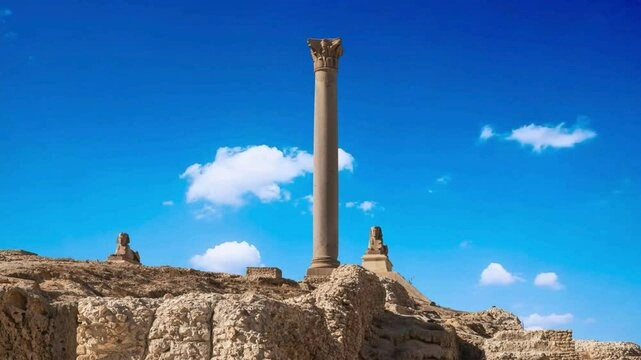
Rising dramatically above the ruins of ancient Alexandria, Pompey’s pillar is one of the tallest ancient columns ever constructed outside Rome, built in the 3rd century CE in honor of Emperor Diocletian. Despite its name, it has no connection to Pompey: it was actually erected around 297CE in honor of Emperor Diocletian, as we said later. It stands as a symbol of Roman authority in Egypt; let's discuss its name in detail. This column has been known by several names throughout different historical periods. Since the 12th century AD, it has been reported that someone saw a dome above the capital of the column, which the Franks assumed was the funerary urn. This was in addition to another mistake they made, stemming from 16th-century drawings depicting a sphere above the top of the column. During the Crusades, the column was mistakenly known as ''Pompey's Pillar''. This error occurred because the Franks believed that Pompey, the Roman commander who fled to Egypt, had escaped from Julius Caesar, been killed by the Egyptians, and had been placed in a precious funerary urn above the capital of the column. They were influenced by the Roman custom of placing the ashes of Emperor Trajan in a funerary urn atop his column in Rome. The crusaders reached this conclusion based on the writings of the famous Arab historian Al-Suyuti. As for the name ''column of the masts''(Amud-Al-Sawari),it dates back to the Arab period. This name likely arose from the tower's great height, which is among four columns resembling ship masts, as mentioned by Al-Suyuti. Therefore, it was called '' Sari-Al-Swari'' which was later linguistically altered into ''Amud-Al-swari'' .
''Pompey's Pillar '' was part of a massive temple complex known as Serapeum, a temple dedicated to the god Serapis. And most of the temple itself has disappeared, leaving the column as the only surviving structure.
Carved from a single piece of red granite, the column demonstrates the engineering skill of ancient craftsmen who transported and erected massive stone blocks without modern machinery. Transporting such a massive monolithic stone from quarries in Aswan to Alexandria, over 800 km away, required extraordinary logistical planning. Workers likely used barges along the Nile and canal routes, then dragged the column using sledges, ropes, rollers, and coordinated manpower. Raising it upright would have required counterweight systems.
The Corinthian capital at the top is elaborately carved with acanthus leaves, demonstrating refined artistry combined with structural engineering. It was not simply decorative: it balanced weight distribution and protected the column's upper surface from erosion.
Exact physical details
Yet the monument is famous not only for its architecture but also for its legends. Travelers in the medieval and early modern periods claimed that the capital was so wide that ancient Roman banquets were held on it, and that it served as a platform for gatherings or even meals. This is physically impossible; the top is wide but not platform- sized, and reaching it would have required dangerous climbing. Historians today confirm this is a myth, but the story reflects how awe can turn into folklore and why it survives: people often exaggerate monuments they find overwhelming. Awe becomes myths.
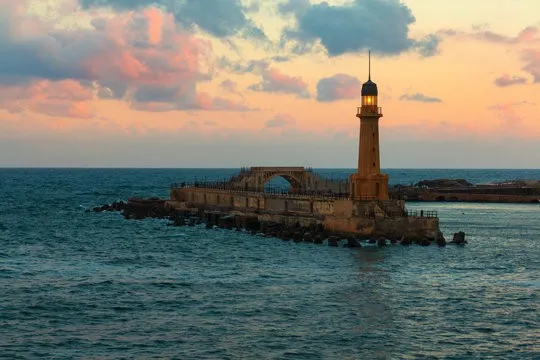
Being constructed in the 3rd century BCE under the Ptolemaic reign, the old lighthouse of Alexandria was grandly built, attaining a height ranking it as one of the tallest structures in the world, its height being recorded as between 100 and 130 meters. It stood on Pharos island, along the causeway known as the Heptastadion, wherein the lighthouse light was visible as a beacon even before the thinnest hint of the main city's features began to emerge. Architecturally speaking, it was, according to historians, a three-tier structure:
A massive fire was burning at the summit of the tower, the light of which was reflected by polished copper or bronze mirrors outside the mandates. These mirrors intensified the light of the flame projected far across the sea, allowing ships to pass safely at night or in fog.
Old-time writers maintained that the light could cover 49 kilometers of distance. Some legends said the mirrors could scorch enemy ships by concentrating sunlight like a huge lens. Exaggerated as it may be, the myth reveals the lighthouse's awe to the ancient watchers. It almost seemed to them that it was not merely an optical technology but also something almost supernatural.
One time, this ancient lighthouse was one of the Seven Wonders of the Ancient World. located at the Pharos Island, it was used to guide ships into port, making use of firelight reflected from polished mirrors-a very early example of applied optics. Ancient writers tell it was a visually breathtaking form, viewable miles afar and serving as a navigational tool, and indeed the emblem of the global significance of Alexandria.
Although it was eclipsed by centuries of earthquakes, its influence lives on: it inspired the lighthouse designs for centuries to come. This is the reason the term "pharos" still stands for "lighthouse" in various languages of the world today. Its destruction by nature has triggered tales of secret chambers and treasures, yet another example where one's creative energies spill into the spaces that history leaves vacant.
The lighthouse was earthquake-resistant for centuries, built with flexible mortar and tightly fitted stone blocks that absorbed seismic shock. After repeated earthquakes between the 10th and 14th centuries, it gradually collapsed. Its stones were later reused in nearby fortifications, meaning its physical form disappeared – but its scientific legacy survived.
The very word “pharos” became the root for ‘’lighthouse’’ in several languages, proving its global influence
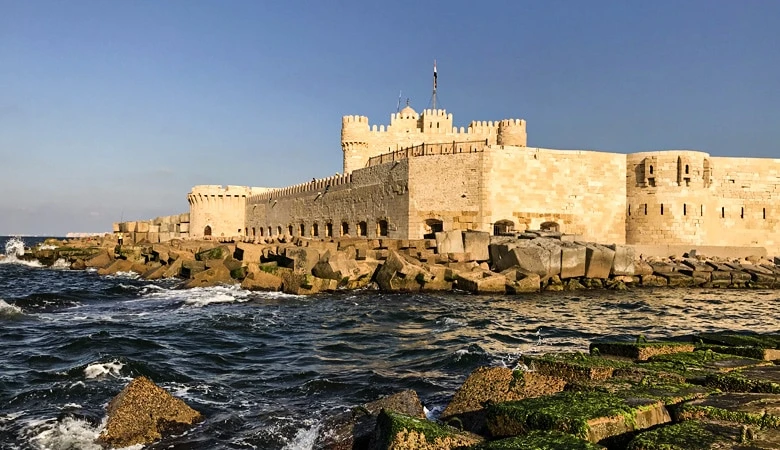
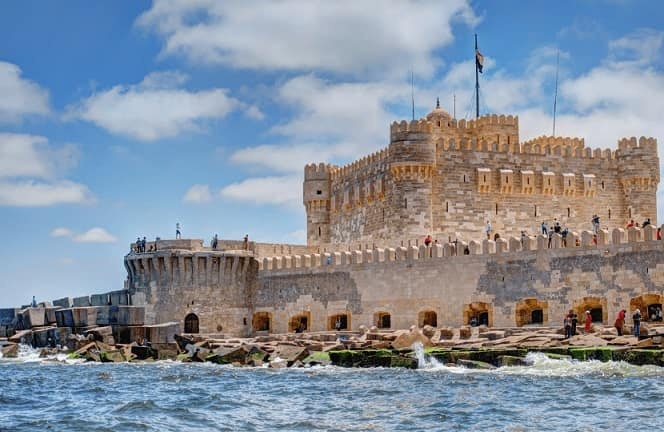
In 1477 AD, Sultan Ashraf Qaitabay Han ordered a fortress built on the lighthouse's exact site to defend for the northern coast of Egypt from an amphibious attack. Builders used stones scavenged from the ruined lighthouse, thus in a symbolic manner turning a scientific monument into a military one, making the foundation of this citadel highly extraordinary. In this way, Alexandria beautifully constructed its future from the past and became one of our best Egypt Tours.
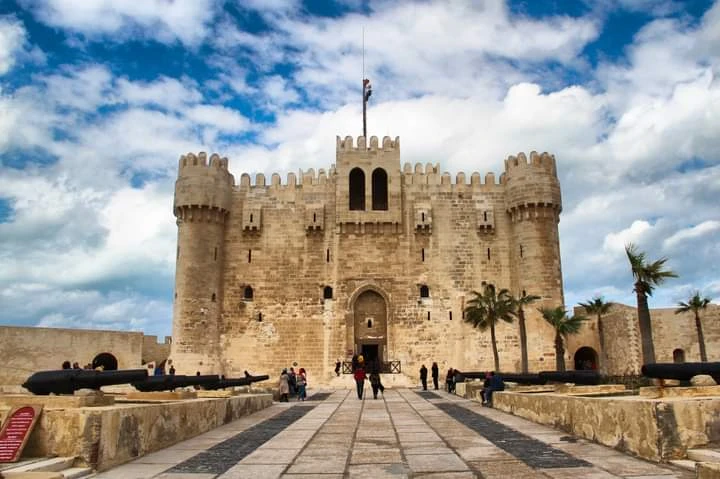
The citadel’s design reflects advanced medieval military engineering :
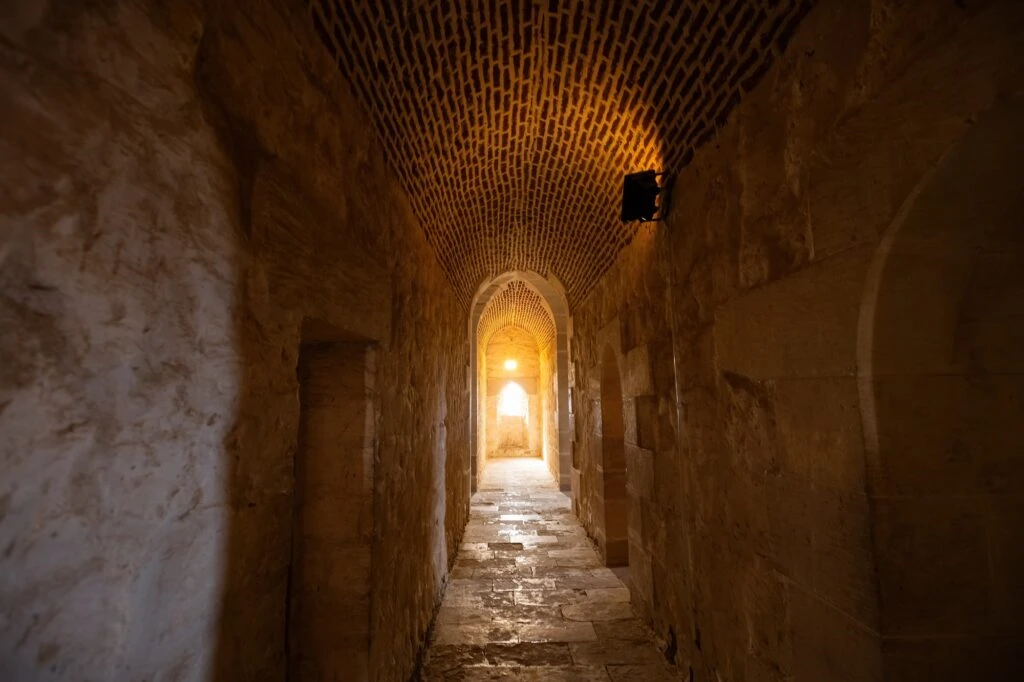
The fort was more of a status symbol than a defense: whoever controlled the harbor at Al-Qunaytirah would control the Mediterranean trade.
Half fragmented Arab and Andalusian cities, as well as other fragments, lie sandwiched between prefecture walls demarcating and governing the medieval town, which is protected by the Qaytbay Fortress. It's hostile along the Mediterranean coast of Egypt where it is braced against any maritime invasion. Its bulky brownish-colored fortifications along the deep-yellow-and-white walls show a Mediterranean feel, weathered to a more forgiving stance while capitalizing on the splendid and rugged coastline of the Mediterranean Sea.
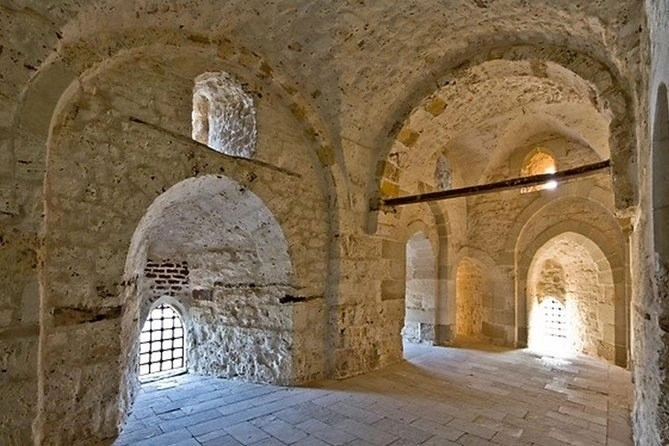
Alexandria’s monuments inspired myths for three reasons:
Thus, myths are not historical errors-They are emotional reactions to greatness
Ultimately, the deeper lesson Alexandria’s monuments teach us is this: What appears mysterious is often simply misunderstood sophistication.
The column shows mastery of stone logistics. The lighthouse reveals the mysteries of physics and optics. The citadel reveals the mystery of mastery in military architecture.
Together, they demonstrate that the ancient and medieval engineers possessed intelligence equal to, if not surpassing, modern designers' creativity, if not their technology.
And also, we have the big lesson that the real miracle is not that these structures inspired myths.
The real miracle is that humans built them at all.
Quite often, it's continuity fundamentally lowering what kind of city and probably Alexandria from many historic cities. Bear in mind that Alexander the Great surely killed history in the cradle when he founded this city; of course, the city does not stand there preserved in time as some sealed archaeological site. The city evolved through the creations of the Hellenistic, Roman, Islamic, and modern Egyptian cities. Every period contributed new architecture, beliefs, and stories. Now, stepping into the city feels almost like turning the pages of a book of history made of stone and surf. Monuments are not disconnected sites but interconnected chapters in the same history book. The Roman column represents imperial power; the lighthouse represents science and scientific progress; and the fortress reflects medieval defense strategies: they come together, thus creating a timeline that tells the rise, the adaptation, and the transformation of civilizations.
Travelers are drawn to Alexandria not only because of what they see, but also because of what they feel. The sound of waves against ancient walls, the sight of ruins beside modern streets and the stories told by guides all create a layered experience. Visitors realize they are standing in a place where philosophers once debated, sailors once navigated by firelight, and empires once competed for control.
In Alexandria, history is not distant- it is present. The city’s greatest attraction is this rare combination of reality and legend, where facts are impressive, and myths are unforgettable.
Find out our latest news, promotions, and professional tips. Know before you book your next Egypt tours
Egypt has many historical sites that you can visit and enjoy. Each tour is different and unique. If you go on a Nile cruise, you can visit Abu Simbel, Aswan, and Luxor in the South and enjoy the temples, tombs, and the treasures of the Nile. In the North, enjoy the Pyramids of Giza, The Egyptian Museum, Sakkara. Mosques, churches in Cairo, and many landmarks located in the city of Alexandria. On the East, Enjoy a beach tour for diving, snorkeling, and swimming in the Red sea. Every city has its charm, history, and flavor where you can do many tours and activities.
Your Egypt Tours is one of Egypt’s leading and most trusted travel agencies, known for its personalized service and expert care. As a top-rated company for Egypt tour packages, we ensure every Egypt trip is safe, seamless, and unforgettable, offering competitive prices, excellent customer service, and the highest standards of quality. With us, you’re always in good hands.
The average cost of a one-week trip in Egypt is around 1600 USD, including visits to tombs, temples, and a Nile cruise. Prices vary depending on the Egypt tours and the level of luxury you choose.
It’s not recommended to drink tap water in Egypt, as it’s highly chlorinated and may cause stomach issues for travelers. During your Egypt tours, it’s best to drink bottled water and use tap water only for washing or brushing your teeth.
The best time to enjoy Egypt tours is from September to March, when the weather is mild and pleasant. During these months, temperatures are ideal for sightseeing and Nile cruises. Summer (May to September) can be very hot, but it’s also a good time for budget travelers.
Egypt is generally hot and sunny most of the year, with winter falling between November and January, and summer peaking from June to August. Winters are mild, while summers can get very hot, especially in Luxor and Aswan. The pleasant weather from September to March makes it the best time to enjoy Egypt tours and explore the country's top attractions comfortably.
Yes, Egypt is a very safe country to visit, with a low crime rate and strong security measures in all tourist areas. The government ensures that accommodations and attractions remain clean and well-monitored for travelers’ comfort. When you book Egypt tours, you’ll find professional guides and organized arrangements that make your trip worry-free and enjoyable.
Egypt offers adventures for every traveler. Explore the majestic Pyramids of Giza, sail along the Nile on a Luxury cruise between Luxor and Aswan, and discover ancient temples and tombs that tell the story of the Pharaohs. Dive or snorkel in the Red Sea at Hurghada and Sharm El Sheikh, or enjoy a relaxing beach escape. Book one of our Egypt tours to experience the perfect mix of history, culture in one unforgettable journey.
Yes, you can, summer is still a great time to explore Egypt! While temperatures can rise to around 45°C, seaside resorts like Hurghada, Sharm El Sheikh, and Marsa Alam offer refreshing escapes with diving and snorkeling opportunities. Sightseeing in the early morning or evening helps you avoid the midday heat. Summer also brings great deals on hotels and services, making it ideal for travelers on a budget. Whether you’re seeking relaxation or adventure, Egypt tours during summer can still be an enjoyable and memorable experience.
Egypt has a modest dress code, especially for women, since it’s a Muslim country. Light, comfortable clothing is fine, but avoid short shorts or skirts. When visiting religious sites, cover your shoulders and knees. During Egypt tours, you can dress casually and comfortably; formal wear is optional unless you want to make your Nile cruise dinner extra special.
You can easily obtain a visa upon arrival at Cairo Airport, the process is simple for USA, UK, Canadian, Australian, and European citizens. The visa costs $25 USD and can be purchased at the visa office before immigration. You can also apply for an E-Visa through the official portal: www.visa2egypt.gov.eg. During your Egypt tours, our team can assist you with all visa-related inquiries to make your arrival smooth and stress-free.
Your Egypt Tours travel agency recommends two weeks so that you can enjoy the temples and tombs of Luxor and Aswan, explore the sights of Cairo, and relax in the Red Sea islands and nature reserves.
The best Egypt Nile River cruise depends on your preferences, budget, and how many nights you wish to spend on board. For a truly unforgettable experience, we recommend a 5-star luxury Nile cruise that offers exceptional comfort and service. If you prefer a more private and intimate journey, choose a Dahabiya Nile cruise, ideal for small groups of around 15 people. For adventurous travelers, the traditional Felucca boats provide a simple and authentic way to sail the Nile during your Egypt tours, though they offer fewer amenities.
The best time to visit Egypt is generally from October to April where it is suitable for outdoor activities and sightseeing.
Egypt travel usually have guided tours to archaeological sites, museums, and historical landmarks. Also have optional activities may include hot air balloon rides over Luxor, snorkeling in the Red Sea, or desert safaris.