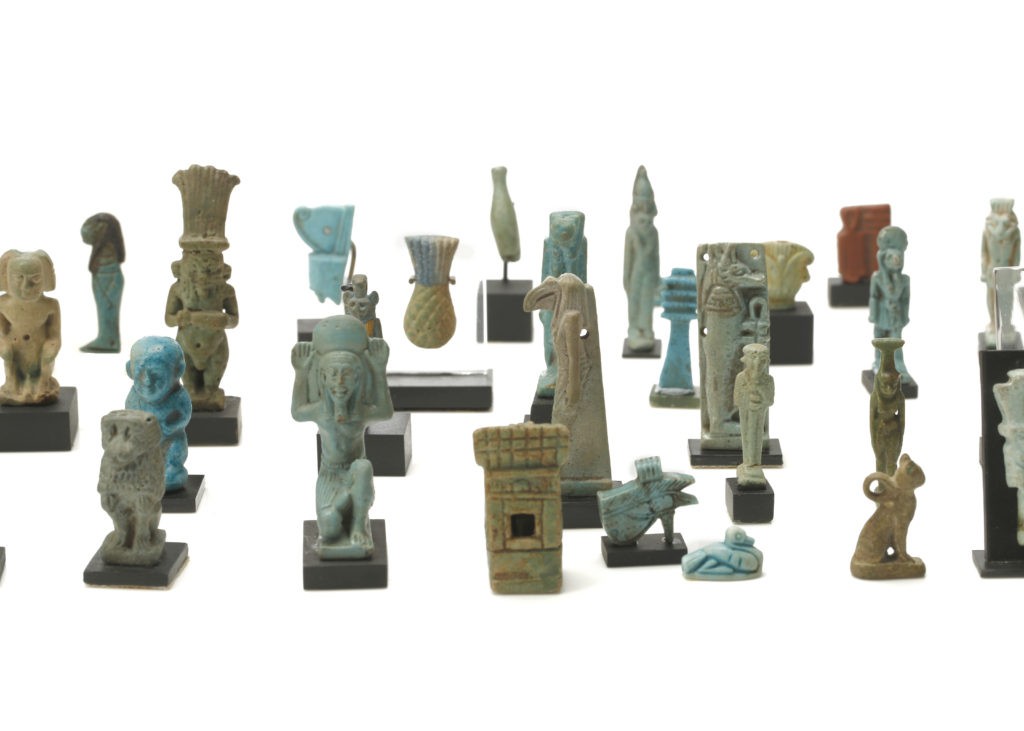
AMULET An amulet is anything worn or carried by a person for protection or good luck. In ancient Egypt, amulets were often small figures of the gods. Of all the magical objects used by the Egyptians, amulets were by far the most popular. Newborns were adorned with amulets to keep them safe and healthy, and parents placed amulets around their children's necks to ward off evil spirits and protect them from scorpions, snakes, and crocodiles.
Amulets, which were created in many variations, were thought to possess a variety of abilities. Some amulets have divine power and served only as protection. Bastet, the cat goddess, would defend you, for instance, if you wore a little cat charm around your neck. A lion amulet would make you bold, a bull amulet would give you strength, and an ibis or baboon amulet would aid you in gaining wisdom and understanding, according to the Egyptians, who also thought that some amulets provided the user extraordinary abilities in addition to keeping them safe.
One of the most popular Egyptian amulets was the EYE OF HORUS, which was worn by the living for good health and also placed on the dead for regeneration. The Eye of Horus is shaped like a stylized falcon's eye, and the Egyptian word for it is unjust, or sound eye. good health and also placed on the dead for regeneration. The Eye of Horus is shaped like a stylized falcon's eye, and the Egyptian word for it is unjust, or sound eye. Faience amulets were produced in workshops all over Egypt. The first step was to prepare a mold.
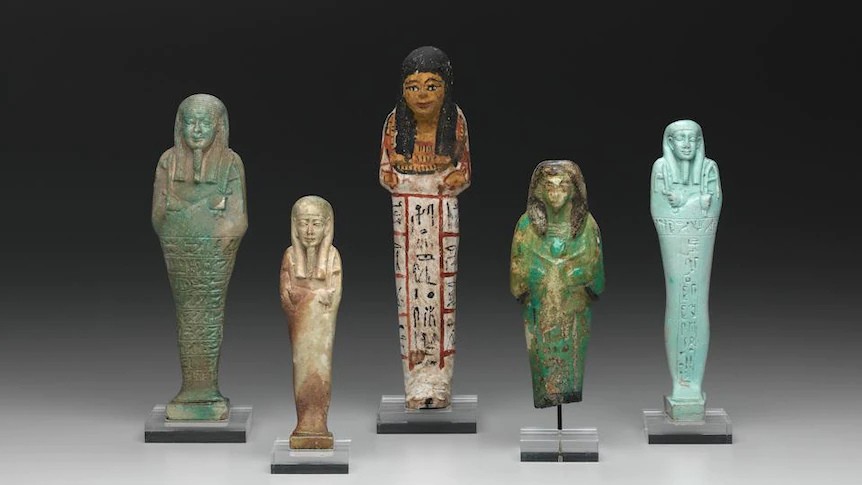
A master amulet was carved, usually in stone, and pressed into a lump of soft clay. The clay was baked or fired until it was hard, and that became the mold used to make amulets. Any number of molds could be made from the master amulet, and any number of amulets could be made from each mold. A small lump of faience was rolled into a ball around a string and pressed into the mold. When the mold was fired, the paste hardened and the string burned away, leaving a hole so the amulet could be strung on a cord. Faience amulets came in many colors, but the ancient Egyptians favored shades of turquoise and blue.
Amulets changed over Egypt's 3,000-year history. Those from the Old Kingdom (2686 - 2181 B.C) tended to be hawks, hippopotami, or lions. Later, in the First Intermediate period (2181 - 2055 B.C), amulets were often in the shape of body parts: arms, hands, feet, hearts, and eyes. The Middle Kingdom produced one of ancient Egypt's most popular amulets, one that is still worn today: the SCARAB beetle.
Amulets from the New Kingdom featured the most well-liked deities. Often, they were inlaid in other types of jewellery or hung on a thread around the neck. Favorites included AMUN ISIS, HATHOR, BES, and TAURET.
Funerary Amulets Some amulets were made to ensure that the mummy remained intact and had the power to resurrect in the next world. The MacGregor Papyrus, a version of the BOOK OF THE DEAD, lists 75 funerary amulets and their uses. The list requires that each amulet be made of gold. Since gold doesn't tarnish, it seemed the most enduring material to protect the mummy for eternity.
One of the most important funerary amulets was the DJED PILLAR, called the backbone of Osiris, which represents stability for the deceased. Chapter 155 in the Book of the Dead calls for a pillar of gold to be placed on the throat of the mummy, but often a string of faience or bone DJed amulets was used because gold was too costly.
Another important funerary amulet was the tet or the KNOT OF ISIS, sometimes called the Girdle of Isis or the Blood of Isis. During the Greek and Roman periods (332 B.C - A.D 395), Isis was identifiable by the distinctive knot on the front of her gown. The tet is often carved from a hard red stone like jasper or carnelian or sometimes molded in red glass. The Book of the Dead suggests the tet should be made of red jasper and dipped into the sap of the ankh-my plant. This plant is not known today, but the name suggests magical power, for it means overseer of life. The ancient Egyptians believed that if the tet was inlaid in sycamore wood and placed on the mummy's neck, the power of Isis would protect him or her.
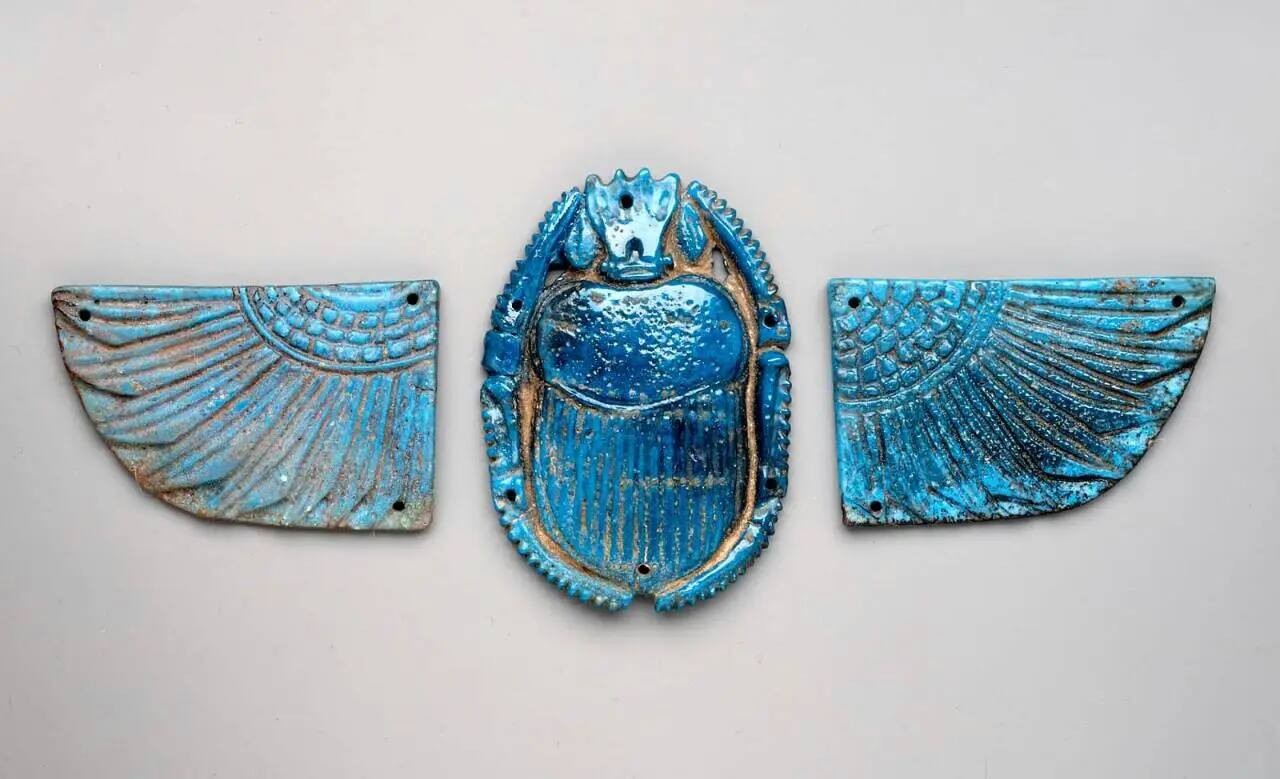
A group of amulets called the FOUR SON OF HORUS were essential for the mummy. All four deities have the body of a man, but each has a different head. Messi is human-headed, Hapi is ape-headed, Duamutef is jackal-headed, and Qebesenef is falcon-headed. Amulets of these four gods were usually made of blue faience and had several holes on each side so they could be sewn onto the mummy wrappings. They were almost always placed across the mummy's chest. Often, a miniature headrest made of hard stone was placed in the mummy wrappings to protect the head of the mummy and to help him or her arise to the next world. Small heart amulets were sometimes wrapped with the mummy to protect the heart and ensure that it did not speak against the deceased when he or she made a plea before the gods.
| Aegis | Miniature of a broad collar necklace with the head of a god worn for protection |
| Bastet | The cat-headed household goddess who brought good luck |
| Bes | The grotesque dwarf god who brought good luck to families |
| Eye of Horus | Eye of the falcon god Horus, worn for good health |
| Isis | The greatest Egyptian goddess, who was the Keeper of Secrets |
| Isis Suckling the Infant Horus | For the protection of mother and child |
| Hathor | Cow-headed goddess of music and dance |
| Horus Falcon | headed protector god |
| Maat | Goddess of truth justice, whose attribute was the feather of truth |
| Nefertum | The god of the blue lotus blossom |
| Nekhbet | The vulture goddess who protected the pharaoh |
| Nephthys | The lady of the mansion and sister of Isis |
| Ptah | The god of craftsmen, and a creator god Ptah Dwarf god protector of children |
| Scarab | Beetle whose image means to exist for protection and to give long life |
| Tauren | Pregnant hippopotamus, for protection during childbirth |
| Thoth | Ibis-headed god of writing and wisdom |
Find out our latest news, promotions, and professional tips. Know before you book your next Egypt tours
Egypt has many historical sites that you can visit and enjoy. Each tour is different and unique. If you go on a Nile cruise, you can visit Abu Simbel, Aswan, and Luxor in the South and enjoy the temples, tombs, and the treasures of the Nile. In the North, enjoy the Pyramids of Giza, The Egyptian Museum, Sakkara. Mosques, churches in Cairo, and many landmarks located in the city of Alexandria. On the East, Enjoy a beach tour for diving, snorkeling, and swimming in the Red sea. Every city has its charm, history, and flavor where you can do many tours and activities.
Your Egypt Tours is one of Egypt’s leading and most trusted travel agencies, known for its personalized service and expert care. As a top-rated company for Egypt tour packages, we ensure every Egypt trip is safe, seamless, and unforgettable, offering competitive prices, excellent customer service, and the highest standards of quality. With us, you’re always in good hands.
The average cost of a one-week trip in Egypt is around 1600 USD, including visits to tombs, temples, and a Nile cruise. Prices vary depending on the Egypt tours and the level of luxury you choose.
It’s not recommended to drink tap water in Egypt, as it’s highly chlorinated and may cause stomach issues for travelers. During your Egypt tours, it’s best to drink bottled water and use tap water only for washing or brushing your teeth.
The best time to enjoy Egypt tours is from September to March, when the weather is mild and pleasant. During these months, temperatures are ideal for sightseeing and Nile cruises. Summer (May to September) can be very hot, but it’s also a good time for budget travelers.
Egypt is generally hot and sunny most of the year, with winter falling between November and January, and summer peaking from June to August. Winters are mild, while summers can get very hot, especially in Luxor and Aswan. The pleasant weather from September to March makes it the best time to enjoy Egypt tours and explore the country's top attractions comfortably.
Yes, Egypt is a very safe country to visit, with a low crime rate and strong security measures in all tourist areas. The government ensures that accommodations and attractions remain clean and well-monitored for travelers’ comfort. When you book Egypt tours, you’ll find professional guides and organized arrangements that make your trip worry-free and enjoyable.
Egypt offers adventures for every traveler. Explore the majestic Pyramids of Giza, sail along the Nile on a Luxury cruise between Luxor and Aswan, and discover ancient temples and tombs that tell the story of the Pharaohs. Dive or snorkel in the Red Sea at Hurghada and Sharm El Sheikh, or enjoy a relaxing beach escape. Book one of our Egypt tours to experience the perfect mix of history, culture in one unforgettable journey.
Yes, you can, summer is still a great time to explore Egypt! While temperatures can rise to around 45°C, seaside resorts like Hurghada, Sharm El Sheikh, and Marsa Alam offer refreshing escapes with diving and snorkeling opportunities. Sightseeing in the early morning or evening helps you avoid the midday heat. Summer also brings great deals on hotels and services, making it ideal for travelers on a budget. Whether you’re seeking relaxation or adventure, Egypt tours during summer can still be an enjoyable and memorable experience.
Egypt has a modest dress code, especially for women, since it’s a Muslim country. Light, comfortable clothing is fine, but avoid short shorts or skirts. When visiting religious sites, cover your shoulders and knees. During Egypt tours, you can dress casually and comfortably; formal wear is optional unless you want to make your Nile cruise dinner extra special.
You can easily obtain a visa upon arrival at Cairo Airport, the process is simple for USA, UK, Canadian, Australian, and European citizens. The visa costs $25 USD and can be purchased at the visa office before immigration. You can also apply for an E-Visa through the official portal: www.visa2egypt.gov.eg. During your Egypt tours, our team can assist you with all visa-related inquiries to make your arrival smooth and stress-free.
Your Egypt Tours travel agency recommends two weeks so that you can enjoy the temples and tombs of Luxor and Aswan, explore the sights of Cairo, and relax in the Red Sea islands and nature reserves.
The best Egypt Nile River cruise depends on your preferences, budget, and how many nights you wish to spend on board. For a truly unforgettable experience, we recommend a 5-star luxury Nile cruise that offers exceptional comfort and service. If you prefer a more private and intimate journey, choose a Dahabiya Nile cruise, ideal for small groups of around 15 people. For adventurous travelers, the traditional Felucca boats provide a simple and authentic way to sail the Nile during your Egypt tours, though they offer fewer amenities.
The best time to visit Egypt is generally from October to April where it is suitable for outdoor activities and sightseeing.
Egypt travel usually have guided tours to archaeological sites, museums, and historical landmarks. Also have optional activities may include hot air balloon rides over Luxor, snorkeling in the Red Sea, or desert safaris.